When you bring a symptom question to a care appointment, it helps to decide what you want the research to explain. You might want to understand the chance of an experience occurring, how much it could interrupt ordinary life, or what evidence would inform a decision about continuing care. Those requests call for different kinds of answers. Before accepting a study summary as relevant, put your question into a sentence that names the experience and the decision. That gives you something concrete against which to read the evidence.
This field guide follows the reasoning between a recorded experience and a conclusion. Check the connections: what qualifies as an observation, what is counted, whose experience is represented, and what would have to be known before using the result for another purpose. An answer that leaves uncertainty can still be useful if it identifies what remains unresolved and why that missing piece matters to the decision you and your care team are considering.
Start with the answer you need
Begin with the quantity you would need to know. A question about whether an experience ever occurs asks for a way to distinguish occurrence from nonoccurrence. A question about repeated disruption asks how experiences accumulate within a person's life. A question about continuing treatment introduces a decision, which might depend on more than either quantity. If these questions are folded into a single request about how difficult treatment is, a concise answer could sound complete while leaving the part you care about unexamined.
Try giving the desired answer a shape before looking for a number. Would it describe people, episodes, time affected, or a choice made under specified circumstances? Then ask what information would make that description fair. Counting experiences would require a rule for separating them. Describing time affected would require a beginning and an end. Interpreting a decision would require knowing what alternatives were available. These are requirements of the question, rather than reasons to expect any particular result.
For basic context, the semaglutide guide is a separate starting point. Here, keep the reading task narrower: decide whether the evidence measures the thing you are asking about. If it measures something adjacent, identify the extra connection that would be needed. That connection deserves examination even when the reported measurement itself seems clear.
Describe what was recorded
Post hoc STEP 1–3 used verbal event reports, follow-up and a 49-day exposure window.
An experience and a record of that experience are separate objects of interpretation. If a description uses broad everyday language, its meaning may depend on what the speaker intended and what the recorder understood. A useful reading question is whether the wording preserves enough detail for the proposed comparison. For a question about timing, an account without a clear beginning or ending would leave something unresolved. For a question about interference with ordinary activities, timing alone would not supply the answer.
Precision also requires a consistent boundary. Suppose the task is to decide whether descriptions refer to a continuing episode or to separate episodes. The distinction needs a rule that could be applied to every account, including an ambiguous one. Otherwise, a change in wording could be mistaken for a change in experience. Asking for that rule does not establish that any particular account was misclassified. It identifies the information needed to distinguish a recording choice from the phenomenon being studied.
A more detailed record would be useful only if its detail serves the question. Asking someone to describe everything imaginable would not, by itself, resolve disagreement about what a measurement means. Decide which uncertainty a proposed detail would settle: the event's boundaries, its practical effect, or its position relative to another observation. This makes the request testable. You can explain how the interpretation would differ depending on the answer, rather than merely asking for a longer description.
Read two counts together
When comparing a count of people with a count of episodes, start by identifying what receives a mark in each tally. One tally can answer whether someone belongs in a category. The other can record each qualifying occurrence. Adding those tallies would mix the objects being counted. It would not reveal a larger population or a more complete measure of burden. A common visual scale can make quantities easy to compare while leaving their meanings distinct.
The next question concerns the arrangement behind the total. If repeated episodes were concentrated among a smaller set of people, the practical experience could differ from a pattern in which repetition was spread more widely. A total alone cannot tell those arrangements apart. To investigate recurrence, you would need records that connect episodes to individuals. To investigate disruption, you would also need a definition of what makes an episode disruptive. Neither question is answered simply by choosing the taller bar.
A useful way to test a proposed interpretation is to ask what could change while the displayed total stayed fixed. The ordering of episodes could change. Their distribution among people could change. Their lengths could change. If your conclusion would change with any of those features, then the total cannot be its complete basis. This is a check on the information required by the claim, not an estimate of which hidden arrangement is most likely.
The figure therefore invites a question about units before a judgment about experience. Keep the labels attached to the quantities when discussing it. Replacing a specific label with a broad word such as burden would introduce a different concept that needs its own definition and evidence.
Two counts
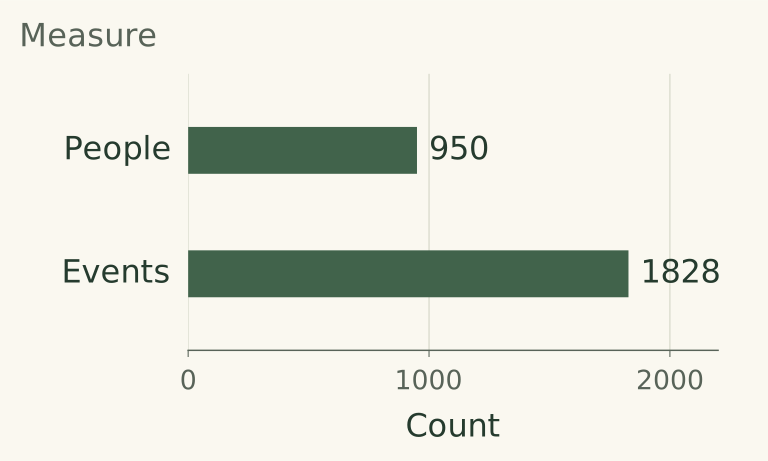
Read the figure as a table
| Measure | Count |
|---|---|
| People | 950 |
| Events | 1828 |
Put disruption beside duration
Severity meant intensity; seriousness, consequences. Semaglutide nausea episodes had an eight-day median. Gastrointestinal events ended treatment in 4.3% with semaglutide versus 0.7% with placebo.
A duration summary is useful for a question about length, but length need not settle a question about disruption. If an episode prevented an important activity, that interruption would matter even if its place in a duration ranking were unremarkable. Conversely, if the question concerns time affected across a period, the record would need to connect separate experiences rather than stop at a summary of individual episodes. Specify the dimension of concern before deciding which description should carry the most weight.
A median is a location within a distribution, not the distribution's entire shape. Knowing its location does not tell you how closely other durations cluster around it or how far the longest experiences extend. It also does not assign a future experience a place in that ordering. To use a duration summary responsibly, distinguish describing a set of recorded lengths from predicting an unobserved length. A prediction would require an additional argument about why the summary is informative for that particular purpose.
Decisions add another dimension. If someone decides that an experience is unacceptable, understanding that judgment could require its effect on daily life, the person's priorities and the available alternatives. A decision should not automatically be read as a direct measurement of intensity. Likewise, a recorded intensity should not stand in for a complete account of what someone was able to do. Keep these interpretations separate enough that one can be examined without silently supplying the others.
You can find the site's established help-oriented material in the side-effect guide. The reading question here remains specific: which description would address your concern about disruption, and what would still be needed after that description was available?
Name the follow-up question
An estimand specifies the treatment question. Treatment discontinuation and a missing measurement are different problems; the intended question determines how each should be handled.
Consider a decision about taking up a plan that might later be changed. If the value of that plan includes what happens after a change, an answer ending beforehand would leave part of the decision unexamined. If the decision instead concerns experience within a particular interval, extending the answer beyond that interval could introduce a different concern. Neither question becomes clearer by leaving its endpoint implicit. Write down what would count as reaching the end of the question, rather than choosing an endpoint because it is convenient to describe.
Now consider a record that ends without an explanation. Several possibilities could deserve investigation, but selecting one without evidence would turn uncertainty into an assumption. The useful response is to ask what each possibility would mean for the answer. Would the conclusion depend on treating unobserved experience as similar to observed experience? Would a different plausible account change the decision? Working through those dependencies makes the uncertainty explicit without declaring which account actually occurred.
The same discipline applies to a reassuringly complete description. Completeness is relative to a purpose. An account could thoroughly cover the period it describes and still omit a period that matters to your decision. Before requesting more follow-up, say what additional question the later information would answer. Otherwise, asking for more can become an open-ended demand with no way to recognize when the evidence is sufficient for the intended use.
Compare the care setting
STEP 3 supplied both randomized groups with intensive behavioral therapy and an initial low-calorie diet. Follow-up included seven weeks off treatment. Novo Nordisk funded the trial and participated in design, analysis and reporting.
To examine a treatment arrangement, describe what is being compared as a whole before trying to assign credit to its parts. If a comparison changes several elements together, the resulting difference would not automatically reveal the contribution of each element. Separating those contributions would require a contrast in which the element of interest could be distinguished from the rest. This matters whenever a claim moves from an entire arrangement to a statement about one component's value.
The reverse inference also deserves care. If surrounding arrangements were shared across groups, that would not establish their irrelevance elsewhere. Their independent contribution would be a separate question. Avoid both attributing all value to the surroundings and assuming they can be removed without affecting the question. Ask which arrangement is being considered and what evidence would support carrying an estimate into it.
For a care conversation, make this practical by naming the services included in the proposed arrangement and the function you expect each to serve. Then distinguish a description of availability from evidence of an effect. Being offered a service and benefiting because of that service are separate propositions. If the proposed connection relies on a comparison that has not been identified, leave the connection open rather than treating a list of services as its proof.
Locate the maintenance start
STEP 4 randomized 803 of 902 run-in participants after target-dose tolerance: 20 weeks preceded randomization. Novo Nordisk funded the trial and participated in its design, conduct, analysis and reporting.
A comparison needs a starting point. If eligibility depends on an earlier experience, the question begins among people who have passed that condition. Asking what happens afterward can be useful. Extending the answer to people who have not yet faced the condition would require a further argument about why that earlier stage does not alter the interpretation.
Separate fairness within a comparison from the reach of its conclusion. Even if a method supports a fair comparison among those included, that does not settle whether the included group represents everyone relevant to another decision. These are distinct tests. One asks whether the contrast can be interpreted within its stated setting. The other asks whether moving the answer to a different starting point would preserve the features on which that interpretation depends.
A decision about continuing something already experienced need not require the same evidence as a decision about beginning it. To examine either, state what is already known at the moment of decision and what remains uncertain afterward. If you move the starting point, reconsider those assumptions rather than simply extending the timeline. This makes applicability a concrete question about the decision's conditions, instead of a vague claim that a study is either relevant or irrelevant to everyday care.
Separate the weight question
Week-68 weight comparisons excluded earlier discontinuers.
A description can be accurate for the records included and still leave an explanatory question open. If two observed experiences occur together, there may be several ways to account for that pattern. One could be part of a causal pathway. Both could reflect another influence. The way records become available could also matter. These are possible structures of explanation, not findings about which structure produced a particular result. Distinguishing them requires information that can separate their predictions.
Ask what would have to change for the causal question to be answered. Comparing people assigned to different treatment conditions addresses a different contrast from comparing people according to an experience that develops afterward. To interpret the latter causally, one would need an argument about why differences connected with group membership do not supply another explanation. Merely giving the groups clear names would not provide that argument. The clarity of a category and the credibility of a causal interpretation are separate achievements.
Missing follow-up poses a different challenge. If an observation is unavailable, the immediate question is how much the conclusion depends on its unknown value. Obtaining it could strengthen the description, yet still leave competing causal explanations unresolved. Conversely, explaining why an experience occurred would not fill in an absent measurement. Keep track of which problem a proposed additional piece of evidence would address. Otherwise, solving one part of the problem could be mistaken for resolving the entire claim.
Specify the outcome you want explained and the comparison that would help explain it. A symptom account, an outcome measurement and a treatment decision need distinct roles in that explanation.
Keep a current safety boundary
Wegovy delays gastric emptying and is not recommended with severe gastroparesis. Contraindications include personal/family medullary thyroid carcinoma history, MEN2 and prior serious hypersensitivity to its ingredients. Persistent or severe abdominal pain needs prompt assessment; vomiting or diarrhea can cause dehydration and kidney injury. Postmarketing obstruction reports establish neither frequency nor causality.
Compounded products are not FDA-approved.
Use these current product statements for their stated purpose. A reading exercise cannot decide how a present concern should be assessed, and a judgment about a research claim is not a judgment about a person's care. Bring that second judgment to the care team directly. For separate reference entries, the peptide library provides a place to examine product and evidence descriptions. Keep that reference task distinct from using a study summary to make a personal treatment choice.
Prepare a bounded conversation
Novo Nordisk funding and employee authorship were disclosed.
Disclosure gives a reader something to examine about the production of an analysis. It does not, by itself, decide whether a particular inference is sound. Scrutiny becomes useful when it names a choice that could matter: what was measured, which comparison was selected, or what assumption connects the calculation to the conclusion. The corresponding question is what evidence would allow that choice to be evaluated.
Bring one unresolved connection into the conversation, with the reason it matters to your decision. For preparation, see the appointment guide. For this reading task, the questions below separate the information needed to describe an experience from the information needed to interpret it.
Questions for a closer reading
Which details would help you interpret my symptom record?
Start with the uncertainty the record is meant to resolve. If the question concerns boundaries, ask which details distinguish an ongoing experience from a separate one. If it concerns practical impact, identify what activity or obligation the description needs to address. The goal is a record whose details could change the interpretation, rather than a longer account with no clear purpose.
What follow-up information would change this assessment?
Ask how a possible answer would affect the conclusion. Information that completes a description may differ from information that separates competing explanations. A useful request names that distinction: would the missing observation establish what happened, help explain why it happened, or affect which decision the evidence can inform? This makes it possible to judge the value of additional follow-up before assuming that more detail resolves every uncertainty.
Which part of the evidence fits the decision we are making now?
Name the decision's starting point and the alternatives under consideration. Then ask which comparison would distinguish those alternatives under the conditions that matter now. If the evidence addresses another stage or another question, identify the connection that would justify using it. Leaving that connection explicit gives your care team a precise issue to assess instead of asking a broad study summary to supply the entire decision.
What to carry into the discussion
A useful reading ends with a claim that has clear boundaries and a question that can be answered. You should be able to say what kind of observation would support the claim, what comparison gives it meaning, and which additional assumption would be needed to carry it into the decision at hand. If that explanation breaks down, locate the break. It might concern the unit being counted, the period being described, the people represented, or the difference between a description and an explanation. Each calls for a different kind of clarification.
That is the contribution a research discussion can make to a care conversation: it can turn a broad concern into an identifiable gap in understanding. Your care team must assess your present situation. The article's reasoning can help you explain what you want to understand and recognize whether an answer addresses it. Keep the unresolved part visible, rather than filling it with an assumption simply because a concise conclusion would feel more satisfying.
Reading limits
This is an editorial reading guide, not an assessment of an individual or a provider. It examines selected research questions and product context rather than every possible clinical issue. The reasoning cannot establish what caused a person's symptoms or determine a treatment choice. No clinician review is claimed.
Educational research analysis. No clinician review is claimed. This article does not provide personal medical advice.