Before using a treatment estimate, identify the claim you want it to support. A description of an average, an explanation of why an outcome occurred, and a prediction for a particular person are different claims. Each needs an argument connecting the available observations to the proposed conclusion. A precise number cannot supply that argument by itself. This distinction matters when discussing symptoms: the immediate concern and the research question may overlap without being interchangeable.
The useful task is to follow that connection rather than search for a reassuring or discouraging number. Start with the comparison, examine how its groups were formed, and ask what happened to information outside its boundaries. Then consider whether an explanation depends on assumptions the comparison cannot test. The aim is a care conversation in which everyone understands what evidence is being used, what question it answers, and what would still need to be assessed.
Read the estimate before using it
A plotted estimate needs a reference: what was measured, over which interval, and relative to what starting point or alternative? Read those elements together. A percentage without its reference could describe a change within a person, a contrast between groups, or a share of an estimated effect. Substituting one meaning for another changes the question even when the printed symbol stays the same.
Next separate the estimate from the people it summarizes. An average does not provide a complete account of individual experiences. To predict a particular person's outcome, a reader would need a defensible connection between that person and the information used for the prediction. Simply finding a familiar group label does not construct that connection.
Uncertainty also has an object. Uncertainty about an estimated average is different from variation among individuals, and both differ from uncertainty about whether a proposed explanation is correct. A graphic can make a comparison easy to inspect while leaving an explanatory question unsettled. Ask which kind of uncertainty would matter to the decision, rather than assuming every uncertainty can be represented by the same bar.
The figure's caption supplies its scope. Keep those qualifications attached when discussing it. For basic product context, the tirzepatide guide is a separate starting point; here the task is to examine what an estimate could justify.
Two groups
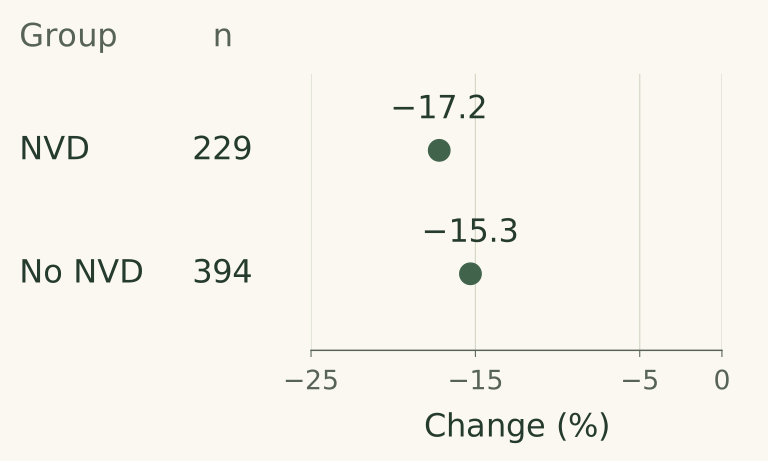
Read the figure as a table
| Group | n | Change (%) |
|---|---|---|
| NVD | 229 | -17.2 |
| No NVD | 394 | -15.3 |
Ask how membership was decided
One episode determined symptom status.
A category is a rule for grouping information, not a complete history. If two different courses satisfy the same rule, their shared label cannot tell a reader which course occurred. This is a loss of detail created by the act of classification. It does not make classification useless, but it means the label must be matched to the question being asked.
Suppose the question concerns the circumstances surrounding an experience rather than whether any qualifying experience occurred. Answering it would require information about timing, persistence or context that a simple category might not retain. The relevant next step is to identify the missing dimension. It would be a mistake to fill that gap with an assumption that every member of the group had a similar experience.
A negative label needs an explicit boundary, too. Failure to meet one definition cannot establish the absence of every other experience. Before using a negative category as reassurance, ask exactly which proposition that category negates.
Group formation also matters to explanation. If membership depends on something observed after treatment begins, the factors placing someone in that group become part of the causal question. A comparison of the resulting groups cannot obtain the logic of randomized assignment merely by borrowing the word randomized from an earlier treatment comparison.
Consider, conditionally, whether the opportunity to report an experience could depend on the amount of observation available. If it could, group membership might reflect both the experience and the chance to record it. That possibility is a question to investigate, not a finding about these participants. A useful care-team discussion would distinguish a person's account from the research category being used to interpret it.
Write the treatment question
SURMOUNT distinguished efficacy during treatment from a treatment-regimen question allowing premature stopping. Its trials differed in eligibility and lead-ins; SURMOUNT-2 included diabetes. Lilly funded the program; five design-report authors were employees/shareholders.
Before judging an estimate, try completing this sentence: the result is intended to describe what would happen to whom, under which approach, over what period. An incomplete sentence reveals an incomplete question. Adding technical detail to the calculation cannot decide which question the reader originally wanted answered.
Consider the difference between evaluating an approach as someone might begin it and evaluating experience under a specified condition of continued participation. Both could be meaningful. They need not supply the same answer, because the conditions built into the questions differ. Calling either answer more realistic without naming the decision leaves the disagreement unresolved.
Eligibility belongs in that sentence because it defines the people to whom the question refers. A characteristic used to define a population is not automatically a proven reason for every outcome difference involving that population. To claim such an explanation, one would need evidence separating the characteristic's role from other differences. Otherwise, a boundary on applicability has been converted into an unsupported causal story.
The beginning of follow-up belongs there as well. A question anchored to starting an approach asks about a different decision from one anchored to a later stage. This distinction can be stated before knowing any result. Ask the care team to identify the decision under discussion first; only then decide whether the research question provides relevant information. Agreement about the question can prevent an apparent disagreement about effectiveness from being a disagreement about what is being evaluated.
Account for the records that end
When does an available record answer the intended question? Consider a record that ends before the period of interest ends. The absence of later observations is an absence of information. It is not, by itself, evidence that the outcome later stayed unchanged, improved or deteriorated.
If the reason information becomes unavailable is related to the outcome, the observed records could support a different picture from the complete set of experiences. This conditional concern does not establish a direction of bias. To argue for a direction, a reader would need additional evidence about the relationship between availability and outcome, rather than an intuition that missing information must be favorable or unfavorable.
Distinguish a gap in observation from an event that changes the question. A treatment decision could be known even when a later measurement is absent; conversely, a later measurement could be available after that decision. Treating the decision and the missing measurement as the same thing would prevent a clear account of what information exists and what the analysis is meant to represent.
More records would reduce one kind of uncertainty only if they supply information relevant to the gap. Repeating measurements from already well-observed circumstances need not reveal what happened in circumstances that remain unobserved.
A statistical model cannot settle that choice of meaning for the reader. If a model fills gaps using assumptions, ask what those assumptions require and what evidence could challenge them. If a question intentionally concerns a narrower set of circumstances, ask whether that narrower question fits the present decision. These inquiries address different problems: uncertainty within an estimate and a mismatch between the estimate and the use proposed for it.
Compare explanations
ICH distinguishes observed post-treatment subgroups from groups defined by potential outcomes. Sensitivity analyses test assumptions for a specified treatment question; a different question requires its own interpretation.
A useful way to examine an explanation is to ask what would count against it. If changing one feature of an analysis leaves a conclusion intact, that may address concern about that feature. It does not logically eliminate an alternative explanation that the change never examined. The strength of a check depends on the challenge it actually poses.
Keep the outcome of a check separate from the range of checks that could have been made. Agreement among several answers is informative only after their relationship is understood. Answers may share assumptions, observations or definitions. To treat agreement as independent confirmation, a reader would need to establish what is independent, rather than count the number of answers.
Consider a claim about what the same person would experience under either alternative. A record of one experience cannot establish both. Something beyond that record must supply the missing comparison.
This provides a practical test for a care conversation: ask which uncertainty a proposed comparison is supposed to resolve. If it addresses a definition, it should be interpreted as evidence about that definition. If the unresolved issue concerns an alternative cause, a different kind of evidence may be required. Precision about the challenge makes the conversation more useful than treating every supporting comparison as a general vote for the conclusion.
Ask what the model can identify
Exploratory SURMOUNT-1–3 mediation reached 3.1% of estimated treatment effect; uncontrolled confounding and multiplicity limit inference.
A pathway claim asks more than whether two observations occur together. It asks whether part of an effect would change through a specified intermediate process. To examine that claim, distinguish the treatment contrast, the proposed intermediate process and the final outcome. These are separate roles in an argument, even when they are represented in one statistical calculation.
Now consider a competing explanation that could influence both the intermediate observation and the outcome. If that explanation has not been adequately addressed, an association could fit more than one causal account. The problem is not solved merely by naming one account a pathway. The reader needs to know what makes the proposed account distinguishable from its alternatives.
The denominator of an effect share deserves equal attention. A fraction of a treatment contrast has meaning in relation to that contrast. A change in bodyweight has meaning in relation to the weight measurement and its reference. Moving a number between those statements would change its units and interpretation. A small-looking fraction cannot be converted into a promise about how much a particular person's weight would change if an experience were absent.
A proposed mechanism should also make a distinguishing prediction. Ask what observation would be expected if the explanation were correct, and what would instead favor an alternative. If every possible observation is treated as support, the explanation offers no practical test.
Nor does identifying a proposed contribution identify everything else. A remaining portion of an estimated effect does not name its own biological explanation. To assign it to a particular mechanism would require another supported argument. For the care team, the useful question is whether a pathway interpretation changes the decision and, if so, which assumptions must hold for that change to be justified. An explanatory model should make those dependencies visible rather than conceal them behind a percentage.
Check where the comparison starts
SURMOUNT-4 randomized continuation or withdrawal after a 36-week lead-in; the randomized phase lasted 52 weeks. Lilly sponsored the trial and participated in design, analysis and reporting.
Consider a choice made before any experience with an approach and a later choice made after experience has accumulated. The alternatives at those points may differ, as may the information available to the person deciding. An answer to the later question cannot simply be moved backward in time without explaining why it remains applicable.
Randomization can clarify a contrast at the point where it occurs while leaving that point's eligibility conditions important. If entry into a comparison requires reaching a particular stage, the relevant question concerns people at that stage. Extending the answer to everyone who might begin would require an argument about those outside the comparison, not just confidence in the comparison itself.
The measurement reference and the decision point should also be kept distinct. A result might summarize change across an interval that begins before the decision being compared. If so, the full change and the effect of the later choice would not be interchangeable quantities. Ask where each clock starts before deciding what a total change means.
In a clinical discussion, this becomes a question about timing: which decision is being evaluated now, and what prior experience is being assumed? That question helps select relevant evidence without turning the duration printed in a report into instructions about how long an individual should continue.
Separate the care process from an effect
Investigators could use supportive measures for gastrointestinal symptoms.
Receiving help and benefiting because of that help are different propositions. To evaluate the latter, a comparison must distinguish what followed the help from what would have happened without it. Merely knowing that assistance was available does not provide the missing alternative.
Selection into support can complicate that comparison. If assistance is sought because a problem is more difficult, a worse subsequent outcome among recipients would not by itself show that assistance caused harm. Equally, improvement after assistance would not by itself establish its effect. Both interpretations require attention to the reasons help was sought and to other changes that could explain what followed.
A service claim needs its own clearly specified comparison. Ask what service was delivered, who received it, what outcome is being attributed to it, and how the proposed evidence separates the service from other influences. This is a request for an evaluable claim, not an assumption that the service works or fails.
For practical checks of documentation, use the provider-check guide. Keep those checks distinct from estimating clinical effects: documentation can establish what is promised or offered, whereas an outcome claim needs evidence suited to that outcome. A familiar treatment name or a research citation does not complete the missing connection between a service and its claimed result.
Separate safety from performance
Zepbound delays gastric emptying and is not recommended with severe gastroparesis. Contraindications include personal/family medullary thyroid carcinoma history, MEN2 and prior serious hypersensitivity to its ingredients. Persistent or severe abdominal pain needs prompt assessment; vomiting or diarrhea can cause dehydration and kidney injury. Postmarketing obstruction reports establish neither frequency nor causality.
Compounded products are not FDA-approved.
A research interpretation is not an assessment of the symptoms someone is experiencing now. Bring that assessment to an appropriate clinician rather than use a group estimate to decide whether an individual concern matters. For separately organized product and status information, the peptide library offers a reference point. Keep the product being discussed explicit so that evidence about one object is not silently applied to another.
Prepare your follow-up question
Lilly funded the analysis; six authors were employees/shareholders.
A disclosure helps identify interests and responsibilities that deserve scrutiny. It does not substitute for checking the argument. A useful appraisal asks whether the question, comparison and proposed explanation remain connected when the result is described in ordinary language. Agreement with the conclusion should not remove that task, and disagreement should not replace it with an assumption about motive.
Bring the discussion back to the decision that prompted it. If comparing arrangements for care, the care-setting guide can help organize practical questions. For the research claim itself, the questions below identify three places where clarification can change what the evidence is being asked to do.
Questions for a closer reading
Which outcome are we trying to understand?
Name the decision first, then specify the outcome and period that would help resolve it. If two people mean different things by success, an estimate cannot settle their disagreement until the desired answer is made explicit.
Which experiences are missing from the comparison we are using?
Ask which information would be needed to extend the comparison beyond its current scope. Distinguish that request from guessing how the unavailable experiences turned out. A useful answer identifies the gap and the evidence that could reduce it.
What evidence would distinguish a treatment effect from the way a group was selected?
Ask what alternative explanation remains possible and which additional observation or comparison could challenge it. The answer should address that explanation directly. Repeating a group label or making the original estimate more precise would not, by itself, resolve the causal question.
What to carry into the discussion
A useful interpretation ends with a clearly bounded answer. State the claim, identify the comparison that supports it, and make the remaining inferential step visible. If that step depends on a condition that has not been established, keep the condition attached to the conclusion. This preserves what the evidence can contribute without asking it to decide more than it can.
For a care conversation, the next task is to connect that bounded answer to the decision at hand. Decide which uncertainty would actually change the choice and what information could reduce it. Sometimes the needed clarification concerns the outcome; sometimes it concerns the comparison or the proposed explanation. Naming that need is progress. It makes the discussion about an answerable question rather than about whether an isolated number sounds encouraging.
Reading limits
This is an analysis of how to read evidence, not an assessment of an individual's symptoms or a care provider's performance. Questions about a person's care require appropriate clinical evaluation. The article does not provide a treatment plan or establish that a particular causal explanation is correct.
Educational research analysis. No clinician review is claimed. This article does not provide personal medical advice.